
What is Dual Connectivity?
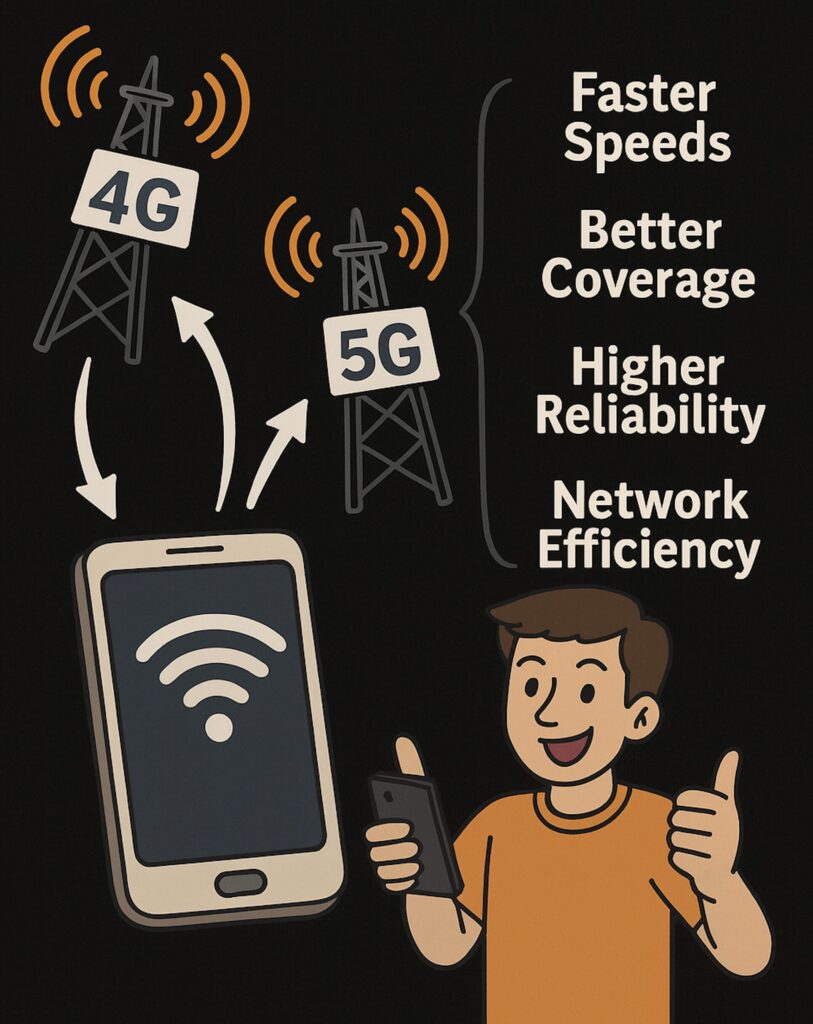
Dual connectivity is a 5G feature that lets your phone connect to two cell towers at the same time. In simple terms, your device can maintain a primary connection (to master node) and a secondary connection (to secondary node) simultaneously. This means your phone can use both connections at once to send and receive data, effectively giving you a boost in speed and reliability.
Watch the video below for a quick overview:
Why Is It Needed?
The short answer is that dual connectivity makes 5G rollout and everyday connectivity much better.
Early 5G networks had limited coverage, so they relied on 4G as an anchor to stay connected. Dual connectivity allows carriers to use existing 4G signals for stability while adding 5G for extra speed. In other words, the older 4G network serves as a stable foundation, while 5G provides the super-fast data on top. This is called Non-Standalone 5G.
This combo helps in several ways: it gives users more bandwidth for higher throughput, makes coverage more robust (since your phone can fall back on 4G if 5G is spotty), and ensures a smoother transition from 4G to 5G for network operators.
Different Types of Dual Connectivity in 5G
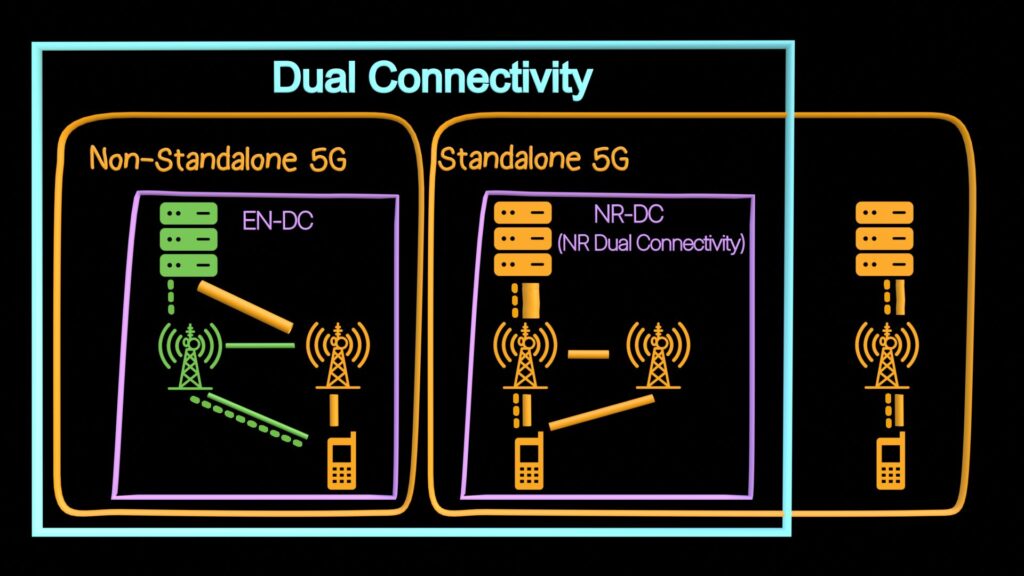
Dual connectivity in 5G can be implemented in different ways, depending on whether the network is Non-Standalone or Standalone. In Non-Standalone 5G (NSA), the most common form is EN-DC (E-UTRAN–NR Dual Connectivity). Here, the 4G base station acts as the master node, connecting to the 4G core, while the 5G base station serves as the secondary node to provide extra data capacity.
In Standalone 5G (SA), the option is NR-DC (New Radio Dual Connectivity), where two 5G base stations work together. One base station connects to the 5G core and handles control functions as the master node, while the second base station provides additional data as the secondary node.
How Does Dual Connectivity Work?
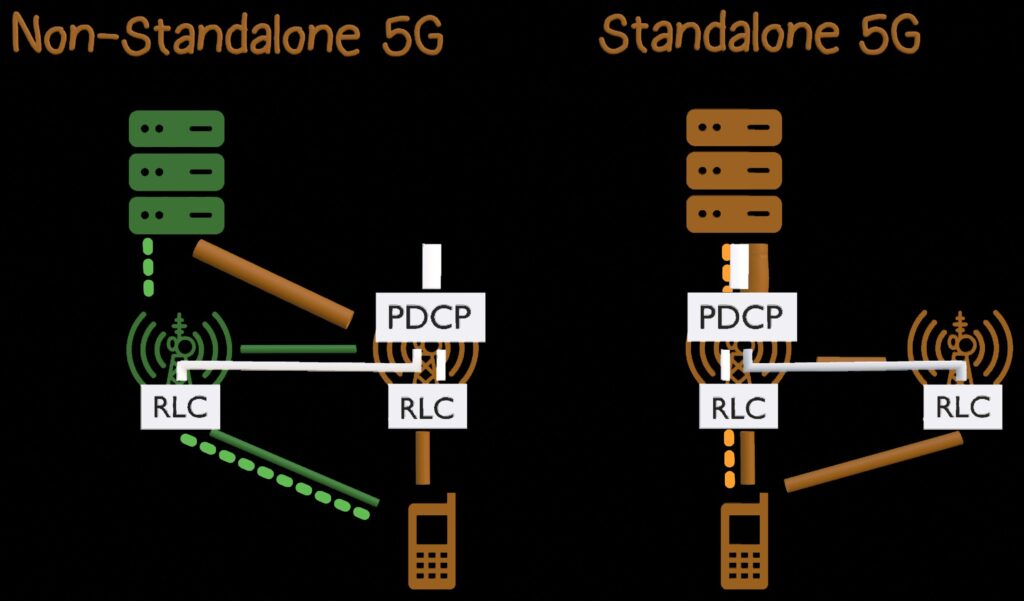
In Dual Connectivity, the PDCP (Packet Data Convergence Protocol) layer splits data for transmission across two different links. In a Non-Standalone 5G (NSA) setup, the higher layer control plane remains anchored on the 4G base station, while the user plane data passes through the PDCP layer in the 5G base station. The PDCP layer divides the incoming data stream and forwards parts of it to the RLC layer of the 4G base station. This way, a single user device can simultaneously receive data from both 4G and 5G.
In Standalone 5G (SA) with NR-DC, the process is similar; the PDCP layer in one base station splits the traffic between its own RLC and the other base stations’ RLC.
A Quick Analogy
If the concept still feels abstract, let’s use a simple analogy:
Imagine a highway: if all traffic is on one lane, it can get slow, and if that lane has an accident, you’re stuck. Dual connectivity is like having a second lane on the highway.
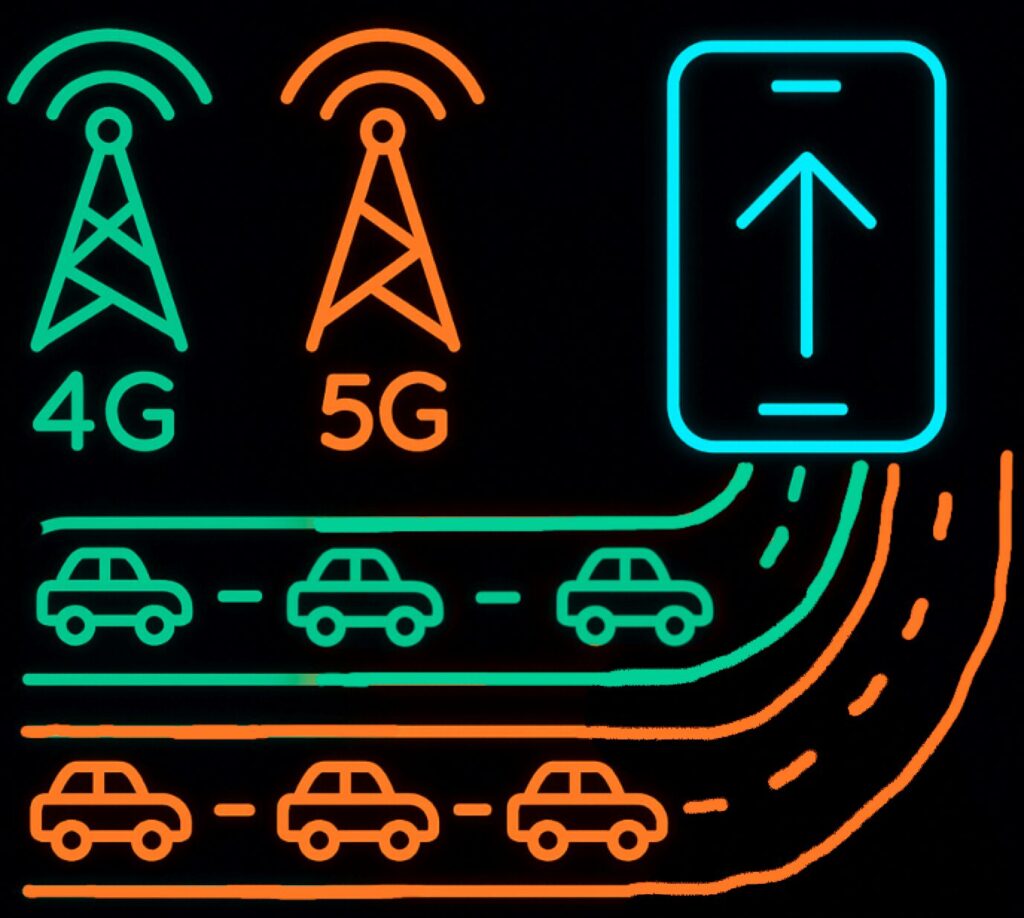
With two lanes open, cars (or in our case, data packets) can drive in parallel and move faster. If one lane has an issue or gets crowded, traffic can shift to the other lane. In the same way, your phone using two connections at once means data has two “roads” to travel. The result? You get to your destination (loading that video or webpage) faster and with fewer hiccups. It’s a two-for-one deal for your connection – more speed and more reliability!
Leave a Reply