
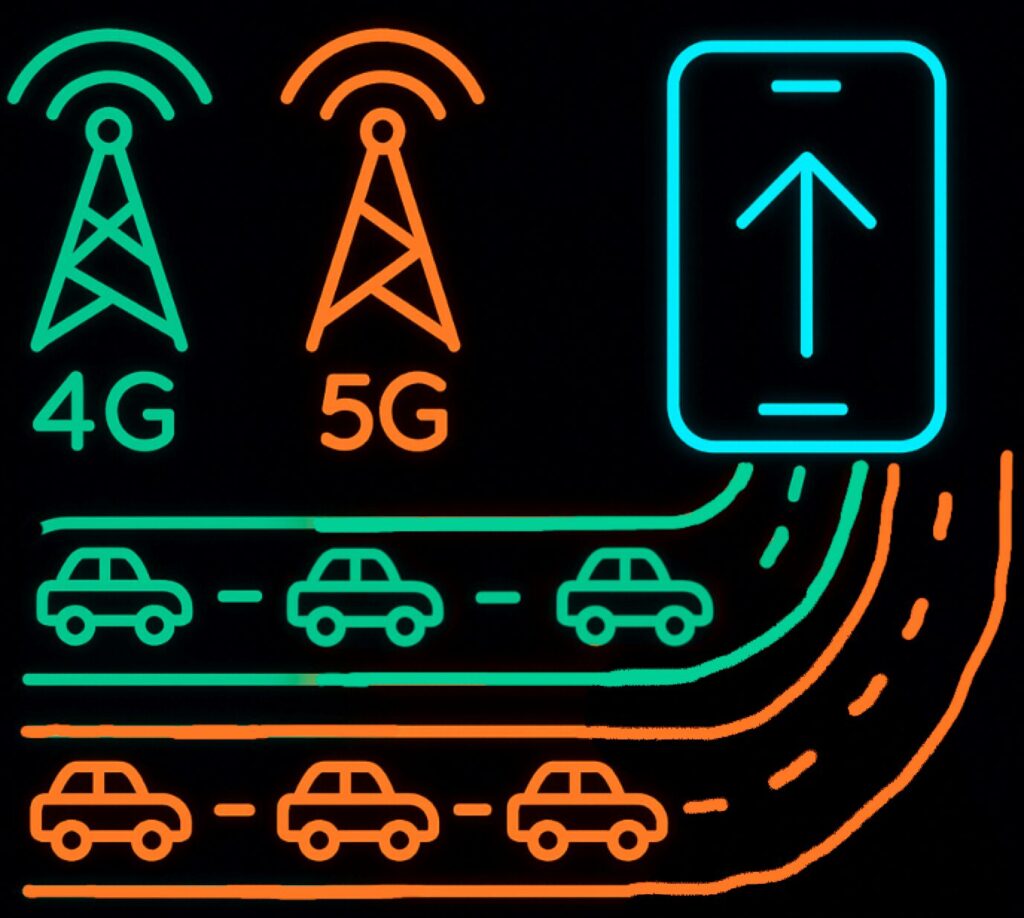
Here’s a little secret about the “5G” icon on your status bar: for years, it probably didn’t mean 5G alone. Your phone was holding hands with a 4G tower and a 5G tower at the same time — and that double handshake is one of the cleverest tricks in modern networking. It’s called dual connectivity, and the easiest way to picture it is a highway that just opened a second lane for your data. Let’s drive that highway end to end.
One phone, two towers, two lanes of data
Dual connectivity is a 5G feature that lets your phone connect to two cell towers at the same time. One tower is the boss — the master node — and it holds your primary connection. The other is the helper — the secondary node — and it carries a secondary connection alongside. Your phone sends and receives data over both links at once. In highway terms: same destination — your phone — but now the traffic flows in two lanes, which buys you the two things every user wants: more speed and more reliability.
Prefer moving pictures? Here’s the whole idea in a few minutes:
But why would a network go to the trouble of running two links for one phone? Because when 5G arrived, it had a road problem.
How 4G carried 5G on its shoulders
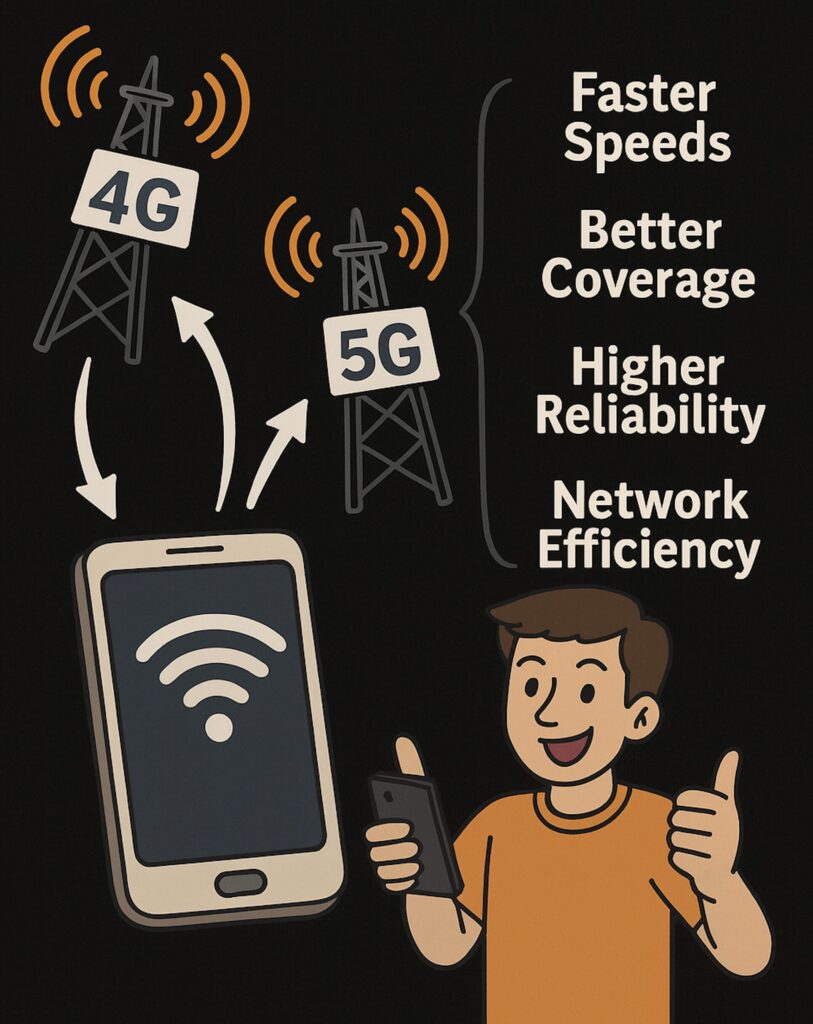
Rewind to the early days of 5G. Coverage was patchy. A brand-new 5G tower might reach a few blocks, while the 4G network next door blanketed the whole city — the shiny new fast lane was paved only in short stretches, while the old lane ran unbroken from end to end. So engineers made a deal: let the trusty 4G network be the stable anchor, and let 5G pour extra speed on top. Your phone stays latched to 4G for the never-drop-the-call basics, while 5G supplies the turbo boost. This 4G-anchored setup is called Non-Standalone 5G — “non-standalone” because the 5G part literally cannot stand alone; it leans on 4G.
The combo pays off in several ways: more bandwidth means higher throughput (faster downloads), coverage gets more robust (your phone falls back on 4G whenever 5G coverage weakens), and operators get a smooth migration path from 4G to 5G instead of a risky overnight switch.
Two networks sharing one job raises an obvious question: who’s in charge of the highway?
EN-DC or NR-DC: who runs the traffic control?
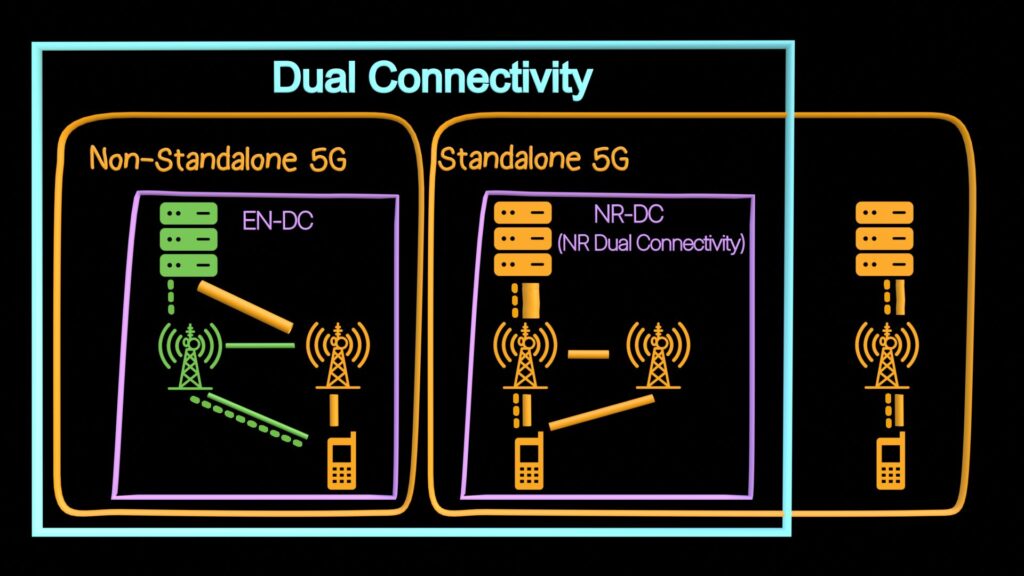
Dual connectivity comes in flavors, depending on which network is in charge.
In Non-Standalone (NSA) 5G, the common form is EN-DC — E-UTRA–NR Dual Connectivity. Don’t let the alphabet soup scare you: E-UTRA is simply the official name for 4G’s radio technology, and NR (New Radio) is the official name for 5G’s radio. In EN-DC, the 4G base station is the master node: it connects to the 4G core network (the network’s brain) and runs the show. The 5G base station is the secondary node, bolted on purely to pump extra data capacity. On our highway, 4G staffs the traffic-control center; the 5G lane exists purely to move more cars.
In Standalone (SA) 5G, the flavor is NR-DC — NR–NR Dual Connectivity — where two 5G base stations team up. One connects to the 5G core and handles the control duties as master node; the other joins as secondary node to add even more data muscle.
Fun bit of history: engineers were in such a hurry to ship this that 3GPP (the body that writes cellular standards) approved the NSA/EN-DC part of Release 15 in December 2017 — months ahead of the Standalone spec — precisely so early 5G could launch by leaning on 4G. And the idea wasn’t even born with 5G: dual connectivity first appeared for LTE back in 3GPP Release 12. (If you ever want the full rulebook, it lives in 3GPP TS 37.340.)
So we know who runs the highway. But where, physically, does one stream of packets become two? Time to pop the hood.
PDCP: the on-ramp where your packets pick a lane
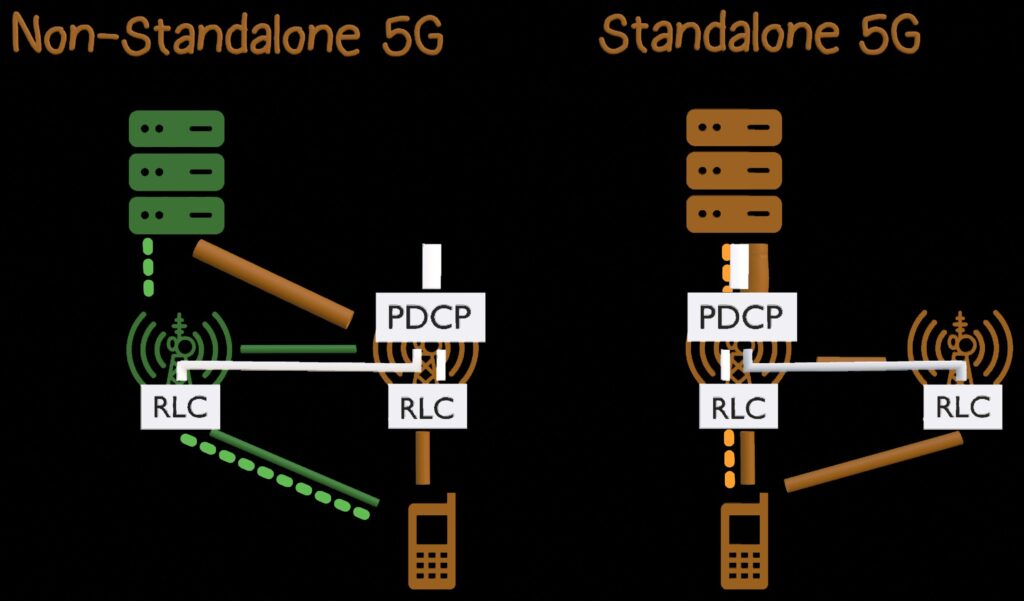
The magic happens in a protocol layer called PDCP — the Packet Data Convergence Protocol. Picture it as the sorting room at the highway on-ramp: packets arrive from the internet, and PDCP waves each one into a lane.
In an NSA setup, the roles are split cleanly. The control plane — all the signaling paperwork — stays anchored at the 4G base station. But the user plane — your actual data — flows through a PDCP layer that, in the most common deployment, sits in the 5G base station. That PDCP layer divides the incoming stream: some packets go down its own transmission chain, and the rest are handed to the 4G base station’s RLC layer (Radio Link Control — the layer below PDCP that manages each individual radio link). Result: one phone, receiving data from 4G and 5G simultaneously. Worth knowing: this split is only one of several flavors the standard allows — the network can also route your data down just the 4G lane or just the 5G lane, with no split at all. But the split we just walked through is the widely adopted one, so it’s the one worth carrying in your head.
In Standalone 5G with NR-DC, the play is the same — the PDCP layer in one 5G base station splits traffic between its own RLC and the other base station’s RLC.
Dual connectivity in one breath
- Your phone holds two radio links at once: a master node (the boss) and a secondary node (the helper)
- It made early 5G possible: 4G anchors the connection, 5G adds speed — that’s Non-Standalone 5G
- EN-DC = 4G master + 5G secondary (NSA); NR-DC = two 5G stations team up (SA)
- The PDCP layer splits packets across the two links — and reorders them neatly at the far end
- Net result: a two-lane highway for your data — more speed, more reliability
So next time your status bar flips to 5G and a page loads in a blink, remember: behind that little icon, two towers may be quietly splitting the work across two lanes at once. Let me know your thoughts in the comments. Until next time — happy learning!
Leave a Reply