
Your plane lands, you flip off airplane mode, and by the time you grab your bag, the 5G icon is glowing. Feels like magic, right? Behind that little icon is a lightning-fast ritual called the RACH procedure — RACH is short for Random Access Channel. It’s the very first handshake between your phone and the nearest cell tower, before any real conversation begins. Let’s walk through it the way you’d walk into a crowded party.
Bonus fact: good news for the 4G crowd — RACH works pretty much the same way in 4G as it does in 5G. Learn it once, understand both.
Want to dive into the details? Watch the video, then read on:
What is the RACH procedure, anyway?
Imagine a crowded party where every guest wants a word with the host. If everyone blurted at once — chaos! The RACH procedure is your phone’s polite way of getting the tower’s attention and asking, “May I connect?” No phone is allowed to just start talking. First it must raise its hand, get noticed, and get a slot. That hand-raise is RACH — but before you can raise your hand, you have to find the host.
First, find the host: the 5G lighthouse signal
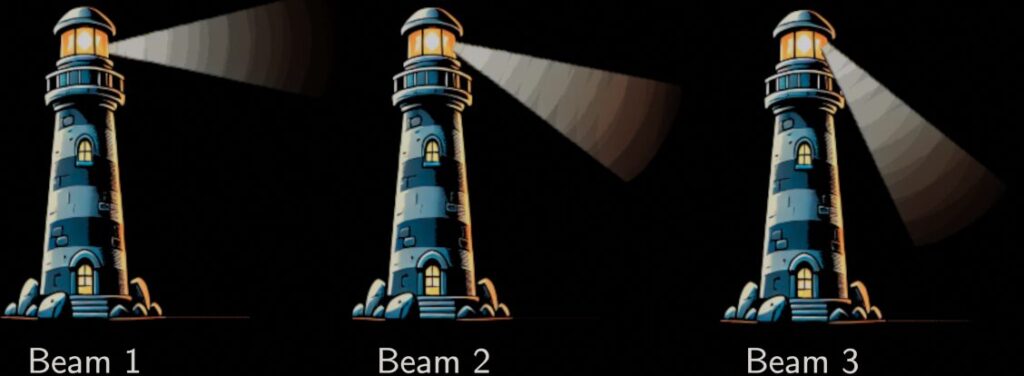
At this party, the host makes itself easy to spot. Picture the 5G tower as a lighthouse with many beams, not just one. Each beam shines in a different direction. Your phone’s mission? Find the strongest, clearest beam.
To help you, the tower broadcasts little “Hey, I’m here!” announcements called SSBs — Synchronization Signal Blocks. They sweep across all the beams, like the lighthouse flashing its light in every direction. Your phone scans beam after beam, listening for those SSB “Hey!” signals until it finds the strongest one. Found it? Beam locked.
Raising your hand — with one of 64 signature waves
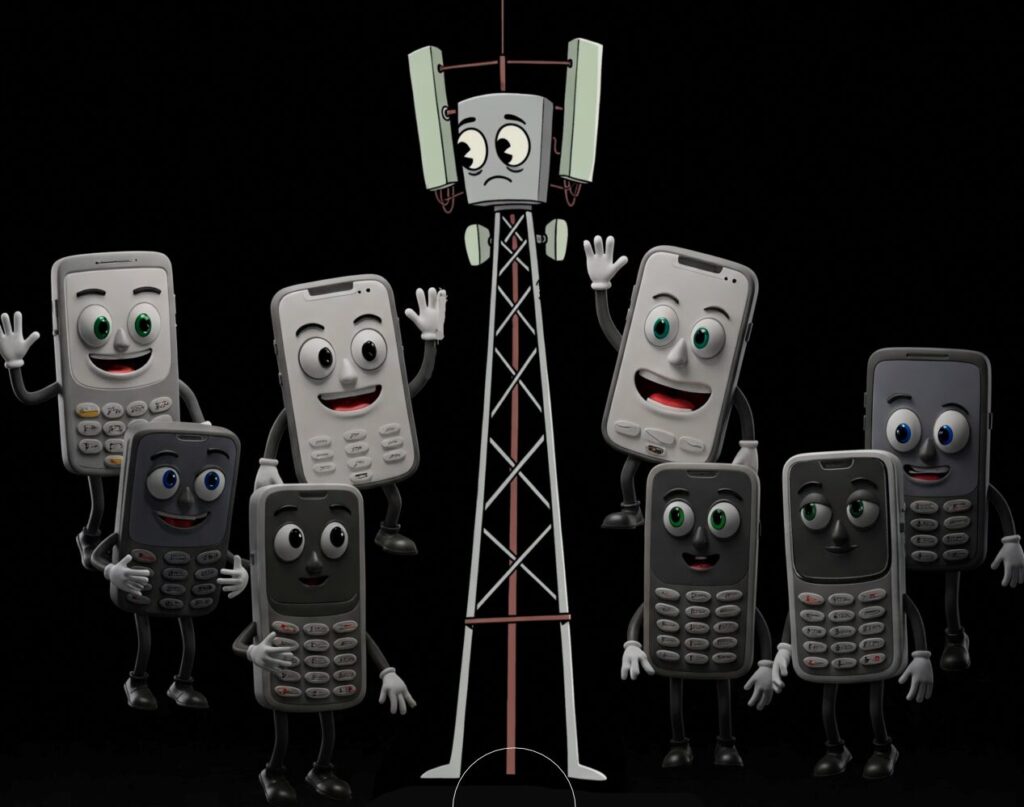
Beam locked, host found — time to raise your hand. Your phone does this by sending a RACH signal — think of it as waving your hand across the crowded party to catch the host’s eye.
This “wave” is a special signal called a Zadoff-Chu sequence. There are 64 different wave patterns to choose from, and your phone picks one at random — like choosing a unique way to wave. Why random? Imagine dozens of people waving at once: different wave styles help the tower tell everyone apart. It’s all about avoiding a chaotic “wave collision.”
Nerd nugget: Zadoff-Chu sequences are named after engineers Solomon Zadoff and David Chu. Their superpower is constant amplitude, zero autocorrelation — a shifted copy of the sequence looks nothing like the original, which is exactly why a tower can pinpoint your wave and its arrival time so cleanly. The 64 preambles per cell are formally defined in 3GPP’s physical-layer spec, TS 38.211.
The tower spots your wave — and clocks your distance
Now the tower has to figure out which wave arrived and when. Picture the host scanning the party and spotting one distinctive wave above the crowd. The tower does exactly that: it knows all 64 possible wave patterns. If you waved with Sequence-2, the tower instantly knows somebody out there is waving with Sequence-2 — not yet who, just which wave.
The tower also measures how long your wave took to arrive — and that travel time reveals your distance. Armed with that, it sends back a Timing Advance command: “To the phone waving with Sequence-2 — I see you! Wave a little earlier next time so your signal lands exactly on time.”
When two guests wave the exact same wave
But wait — what if two phones accidentally pick the same wave at the same moment? Uh oh, signal clash! Two people waving identical Sequence-2 waves, both convinced the tower’s reply is meant for them. Confusion!
Here’s the fix. After the wave and the tower’s timing reply, each phone shouts a random “name tag” to the tower — like yelling your name right after waving. The tower answers with whichever name tag it heard clearly (usually the closer, stronger phone wins), and hands that phone a “VIP pass.” If your phone sees its own name tag come back with that VIP pass — connection success! The other phone realizes it lost the round and simply tries waving again a moment later. This tidy little tie-breaker is called contention resolution.


Let’s recap the whole exchange — four messages, start to finish:
- Message 1 — Phone: “Waving hello!”
- Message 2 — Tower: “Hello back — adjust your timing!”
- Message 3 — Phone: “It’s me, [random name tag]!”
- Message 4 — Tower: “Welcome, [random name tag] — handshake confirmed for you!”
So far, that’s the queue every stranger stands in. But some guests never queue at all.
The VIP lane — contention-free RACH
Imagine arriving with a VIP pass already in hand — no random waving, no name tags, no doorway scrum. You flash your pass and walk right in. That’s contention-free RACH.
The classic example is handover — when your phone glides from one tower to the next while you’re on the move. The old tower tells your phone exactly when, where, and with which reserved wave to greet the new tower. No random picking, no name tags, no clash possible.

The result? Just two messages instead of four. Wave with your reserved pattern, get the acknowledgement, done. Smooth connection guaranteed — which is exactly why your video call survives a highway drive past a dozen towers.
One more nugget: engineers keep shaving this handshake down. 3GPP Release 16 introduced a 2-step RACH that bundles the four messages into just two (nicknamed MsgA and MsgB) — even first-time strangers get a faster hello.
RACH in one breath
- RACH is the “let’s connect!” handshake your phone performs before any real communication
- It starts with a beam hunt: scanning SSB signals to lock the strongest lighthouse beam
- Your phone “waves” with a random Zadoff-Chu sequence — one of 64 patterns
- The tower measures your wave’s arrival time and issues a Timing Advance to keep everyone in rhythm
- Contention resolution settles wave clashes with random name tags and a VIP pass
- Handovers ride the contention-free VIP lane — two messages instead of four
Next time that 5G icon lights up on your way to the baggage belt, spare a thought for the party your phone just crashed — it found the host, raised its hand, and walked away with a VIP pass, all in a few milliseconds. Let me know your thoughts in the comments. Until next time — happy learning!
Leave a Reply