
Here’s a small mystery from your living room: you replace an old Wi-Fi router with a new one — same power plug, same corner shelf — and suddenly the far bedroom gets full bars. A big part of that upgrade is a trick called beamforming. To see what it does, imagine shouting to a friend across a big field. Yell in every direction and your voice spreads thin — by the time it reaches them, it’s a whisper. But what if you could focus your voice into a narrow beam aimed straight at your friend, like a flashlight? That’s exactly what beamforming does in wireless: it focuses a signal in one direction instead of letting it spill out everywhere.
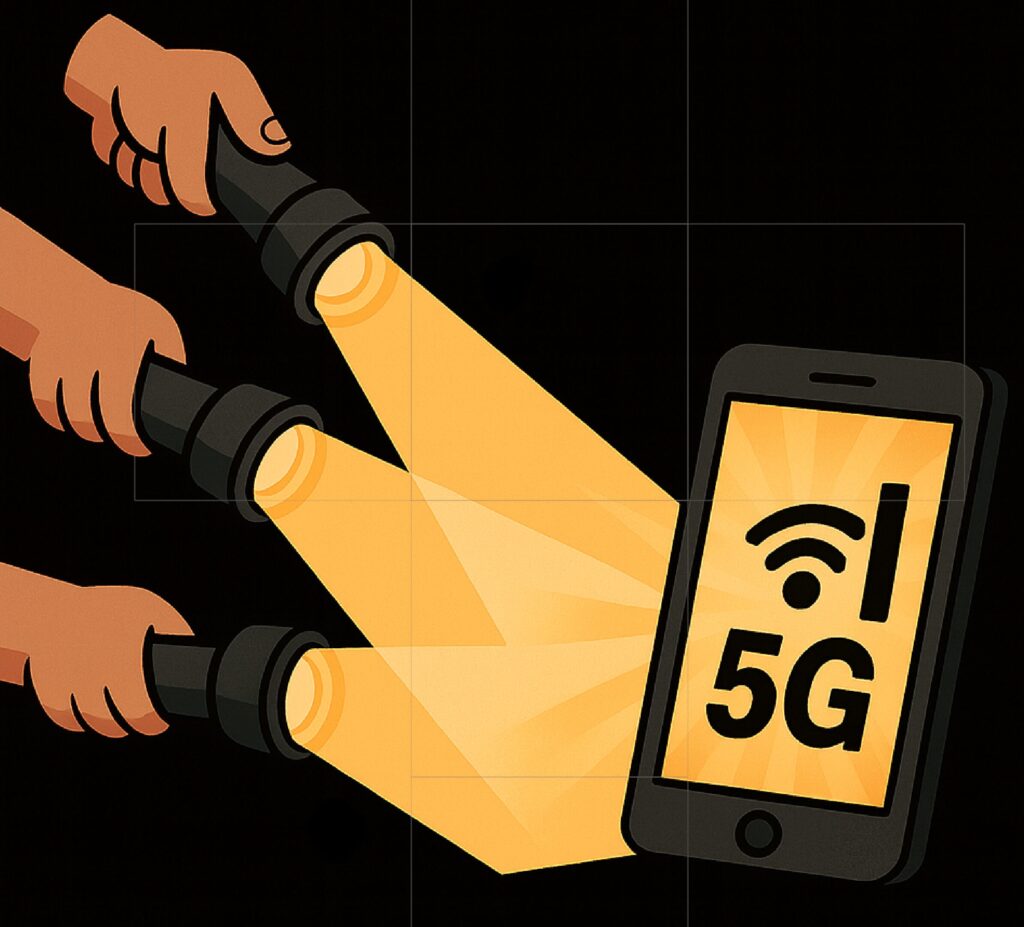
Or picture it with light. One lamp lights a whole room dimly. A bunch of flashlights all pointed at the same spot make that spot blazingly bright — with the same total light.
In practice, beamforming lets a Wi-Fi router or a 5G cell tower steer its energy toward a specific receiver — your phone, your laptop. The signal arrives stronger and reaches farther, without any extra transmit power. The energy was always there; now it’s simply spent where it matters.
Watch the full video lecture below to see these concepts in action:
From ripples to radio waves
To understand how beamforming works, start with something you’ve seen before: ripples on water. Toss two pebbles into a pond at the same time. Each pebble sends out expanding circular waves, and where the two sets of ripples overlap, they combine. In some spots the peaks line up and stack into a taller wave. In other spots a peak lands on a valley — a low point of the other ripple — and they cancel, leaving the water almost calm.
This behavior — waves adding up or wiping each other out — is called interference, and it’s the entire engine behind beamforming. Radio waves are waves too, so they play by the same rules.
When waves gang up — and when they wipe each other out
Those two outcomes are so important they get their own names:
- Constructive interference (adding up). Two waves meet in sync — their peaks arrive at the same time. They stack together into a bigger wave. In wireless terms: a stronger signal. Beamforming uses this to amplify the signal toward the intended receiver.
- Destructive interference (cancelling out). The opposite. The peak of one wave meets the valley of another, and they erase each other — a much smaller wave, or none at all. This is exactly how noise-cancelling headphones work: they play a “mirror” of the unwanted noise to silence it. Beamforming uses it to quiet the signal in directions we don’t want it to go.
In short: beamforming means boosting the signal where you want it with constructive interference, and hushing it where you don’t with destructive interference.
Steering a beam with zero moving parts
So how do we aim a radio signal? You can’t grab a wave and point it like a laser pointer… or can you? The trick is surprisingly simple: use multiple antennas, and adjust the timing of the signal each one sends. (Engineers call this adjusting the phase of each signal — but it’s easiest to picture as tiny time delays.)
Back to the pond. This time, drop the two pebbles one just after the other instead of together. The second set of ripples starts a moment late — so at a certain angle, its peaks catch up and line up perfectly with the peaks of the first set. In that direction, the waves reinforce into one big ripple. Change the delay between the drops, and you change the angle where they line up.
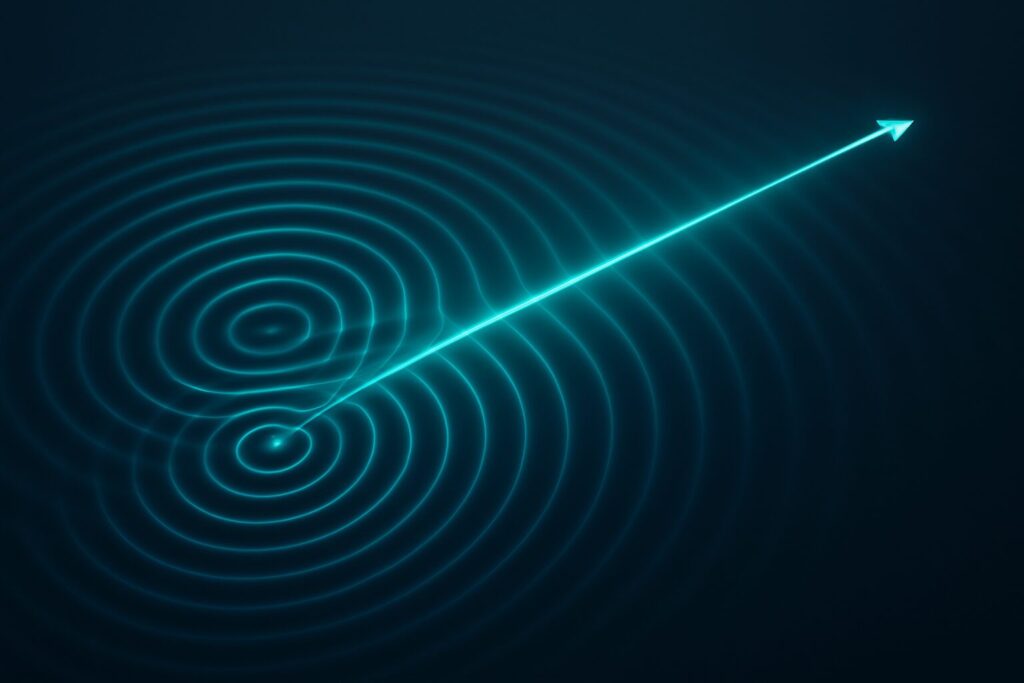
Antennas pull the same trick with radio waves. They never physically turn toward your device. Instead, several antennas transmit the same signal with slight timing differences. If the leftmost antenna fires a nanosecond before its neighbor — and a radio wave travels only about 30 cm in a nanosecond — the combined wave comes out strongest at an angle toward the right.
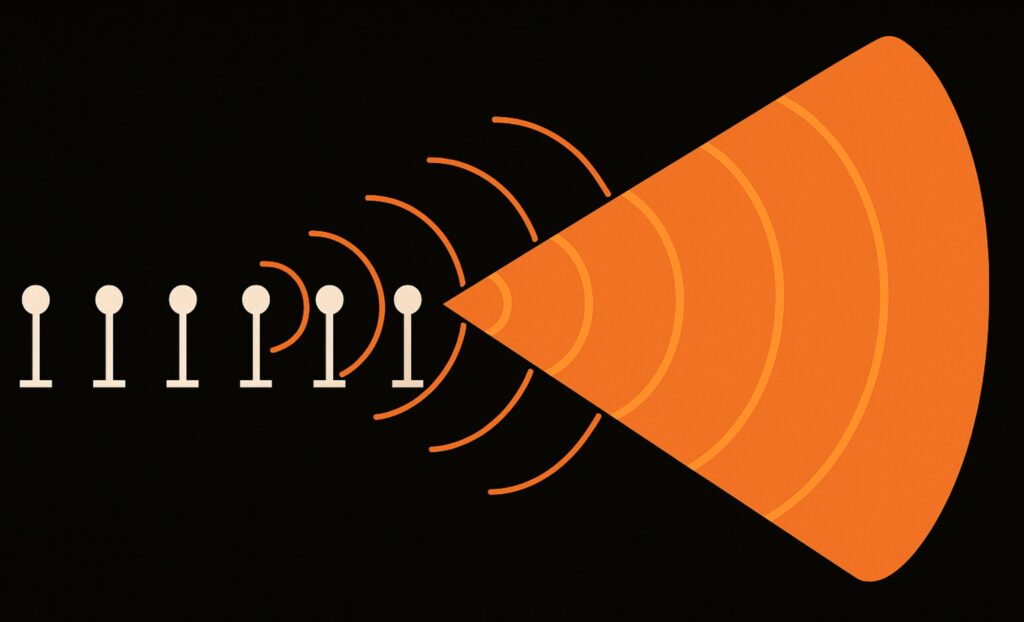
Delay is the steering wheel. Adjust the delay at each antenna, and you steer the beam — the waves meet in phase (constructively) in exactly the direction you chose. Because this filters energy by direction in space, the technique is also called spatial filtering.
The second knob: drop some pebbles harder
Here’s the second trick: you don’t have to feed every antenna the same amount of power. Back at the pond, that means dropping some pebbles harder than others. Give a little more power to the antennas best placed to reach the receiver, and a little less to the rest, and the combined signal grows even stronger in the direction you want — and weaker everywhere else. Again, no extra total power. You’re just spending the same power budget more wisely.

So in a nutshell, beamforming comes down to timing and power. Send the signal from each antenna at just the right moment, with just the right strength, and all those waves arrive as one big, focused push — exactly where you aimed it.
Why beamforming matters
Beamforming is everywhere in modern wireless — remember that far bedroom? Your newer Wi-Fi router earned its bars by aiming, not shouting louder. The numbers get serious on the cellular side: a modern 5G “massive MIMO” panel packs hundreds of small antennas, and firing them all in step can land many times more power on your phone than a single antenna could — all with the same total power budget. Those towers steer beams that follow your phone as you walk, so the connection feels fast and steady. Radar systems use the same trick to track fast-moving airplanes, and satellites use it to keep their beams locked onto ground stations even while racing across the sky — and in both cases, no motor turns and no dish rotates. The beam is re-aimed purely electronically.
It also cuts down on wireless clutter. Because energy goes only where it’s needed, your neighbour’s focused Wi-Fi beam is far less likely to trample yours — and vice versa. And remember destructive interference? Systems sometimes use it deliberately, steering a “null” — a quiet zone — toward other equipment so as not to disturb it. One technique, two superpowers: shout at your friend, whisper past everyone else.
Beamforming in one breath
- Beamforming focuses a signal in one direction — flashlight, not lamp
- It runs on interference: waves add up in sync, cancel out of sync
- Delay is the steering wheel — timing offsets between antennas aim the beam
- Uneven power across antennas sharpens it further — same total power
- Payoff: stronger links, longer range, and less interference for everyone else
Next time your video call stays crisp while you wander around the house, picture the pond — somewhere nearby, a row of antennas is dropping perfectly timed pebbles, millions of times a second, and every ripple is aimed at you. Let me know your thoughts in the comments. Until next time — happy learning!
Leave a Reply