
Your phone has a sneaky superpower. All day long, it takes thousands of tiny naps — each nap timed so perfectly that you never notice a lag. The trick is called DRX, short for Discontinuous Reception. It sounds technical, but the idea is beautifully simple: your phone “sleeps” smart and wakes up just in time to catch the signals that matter. That’s it. And because the radio is one of the hungriest components in your phone, this one trick quietly saves you serious battery — on both 5G and 4G networks.
Want the deeper technical dive? Watch the video below — then read on for the intuition.
Your phone & the 5G tower: a sleepy relationship
Picture your phone and the 5G tower as two friends who don’t need to talk all the time. When you’re not actively using your phone, why should its radio stay on? It can sleep — and save battery.
The rulebook managing this friendship is called RRC (Radio Resource Control) — the protocol that decides how “connected” your phone is at any moment. It gives your phone three connection states. Think of them as three sleep modes:
- RRC Connected — wide awake and chatty. You’re actively using data, so the phone is fully busy sending and receiving. Think “full power mode.”
- RRC Idle — deep sleep. The phone isn’t actively connected, but it can reconnect when needed. Think “ultra battery save mode.”
- RRC Inactive — light nap. The middle ground. The phone dozes, but the network keeps its paperwork from the last session on file — so it can jump back in almost instantly when called. Think “standby mode.”
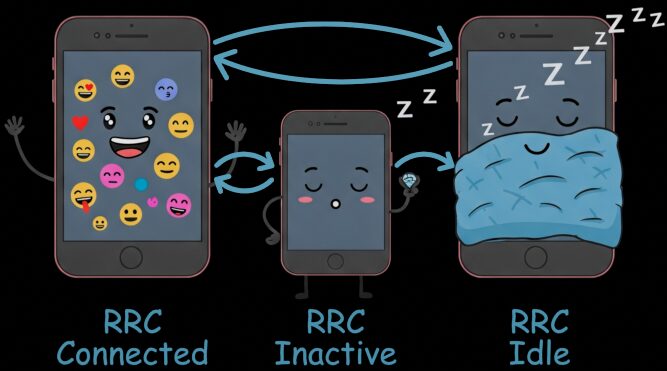
Here’s how it plays out. Scrolling through photos stored on your phone? It happily stays in Idle or Inactive — no network needed. Open TikTok? It jumps to Connected mode almost instantly.
Fun fact: that light-nap state is the newcomer of the family. 4G LTE launched with only Connected and Idle — the Inactive state debuted with the very first 5G standard, 3GPP Release 15 (2018), precisely to make wake-ups faster without burning battery.
DRX: the snooze button for your phone’s radio
So your phone naps — but it isn’t napping randomly. It follows a smart sleep schedule called DRX cycles. Think of it like setting an alarm, except the alarm is for checking in with the network:
- Sleep time: the phone chills out, the radio takes a break, the battery smiles.
- Wake-up time: the phone briefly opens its ears and listens: “anything for me?” — pure listening, it doesn’t even have to transmit.
- Back to sleep: nothing new? Straight back to bed.
It’s like hitting “snooze” — except your phone is snoozing its connection to the network. And here’s the clever bit: the tower and your phone are perfectly in sync. The tower only tries to “talk” when your phone is scheduled to be awake and listening. No wasted shouting at a sleeping phone.
And DRX isn’t some shiny 5G invention. The discontinuous reception trick has been saving phone batteries since the 2G GSM days — 5G just plays the game with far finer timing.
CDRX: naps even when you’re online
Okay, so we get DRX — sleep and wake cycles while the phone is idle. But what about when you’re actively using your phone, sitting in that RRC Connected state? Can it still sneak in power-saving naps? Yes! That’s exactly what CDRX (Connected Mode DRX) is for.
Even in Connected mode, your phone is a power-saving ninja. It:
- Takes tiny data naps: between bursts of data transfer, it sneaks in mini-sleeps.
- Wakes up just in time: right before the next data is expected.
- Naps, wakes, repeats: constantly cycling between short sleeps and wake-ups.
There’s a trade-off hiding here. Longer naps save more battery but may slow responses slightly. Shorter naps keep everything snappy but burn more power. The network juggles these cycles on the fly to get you both battery life and speed.
These aren’t vague ideas, by the way — in the official 5G rulebook, 3GPP TS 38.321, the naps run on real, named timers like drx-onDurationTimer (how long to listen each cycle) and drx-InactivityTimer (how long to stay up after fresh data), with cycle lengths configurable from 10 milliseconds up to 10.24 seconds.
Event-based wake-ups: when the nap gets cancelled
Sometimes your phone needs to stay awake longer — even when its schedule says “snooze.” 5G handles this with event-based wake-ups. Three classic examples:
- Incoming data: if the network starts sending, your phone stays awake to catch the full transmission — like staying alert when the delivery truck pulls up, because more packages are coming.
- Transmission errors: if a chunk arrives corrupted, the phone fires back a NACK (a negative acknowledgement) and stays awake for the tower’s retransmission.
- Awaiting a response: after sending data, the phone may stay active briefly, waiting for the tower’s confirmation.
These smart adjustments cut wasted wake time and squeeze out even more efficiency. The schedule sets the rhythm; events bend it when reality demands.
Why you never catch your phone napping
Zoom out, and the whole scheme is disarmingly simple:
- Stealthy power saving: your phone saves power constantly, without you noticing a thing.
- Synced sleep schedule: phone and tower run perfectly matched sleep/wake cycles.
- Wake up only when needed: the phone stays up longer only when there’s a good reason.
- Longer battery life, happy you: all these tricks together mean fewer trips to the charger.
DRX in one breath
- DRX = your phone sleeps smart and wakes on schedule to check for signals
- Three RRC states: Connected (awake), Idle (deep sleep), Inactive (light nap — new in 5G)
- CDRX sneaks tiny naps in even while you’re actively online
- Longer naps save battery; shorter naps cut delay — the network balances both
- Event-based wake-ups keep the phone up only when data, errors, or replies demand it
- Even in deep sleep, the phone peeks for paging (“it’s for you!”) about every 1.28 seconds
Next time your phone breezes through a long day, remember — it’s not just a bigger battery. It’s thousands of perfectly timed naps: smart 5G power saving at work. Let me know your thoughts in the comments. Until next time — happy learning!
Leave a Reply