
Ever noticed how your phone’s battery drains faster when you’re far from a cell tower — those one-bar days at the edge of coverage? That’s no coincidence. Far from the tower, your phone has to shout — and shouting burns a lot of energy. Right next to the tower, it whispers, and the battery barely notices.
The referee setting that volume — loud enough for the tower to hear you clearly, never so loud that you drown out every other phone in the neighbourhood — is called Uplink Power Control. In both 5G and 4G, it continuously adjusts your phone’s transmit power so the base station receives your signal at just the right strength. Not a decibel more, not a decibel less.

Watch the full video below to see these concepts in action:
One tower, a whole neighbourhood of voices
First, one word of jargon: uplink simply means the direction from your phone up to the tower (the base station). Uplink Power Control is the process of dynamically adjusting your phone’s transmit power when sending signals in that direction.
Think of how you adjust your voice in a conversation — if you’re close, you speak softly; if you’re far away or in a noisy room, you speak louder. Your phone does exactly the same thing — adjusting its volume hundreds of times a second.
The goal is for every phone’s signal to arrive at the tower with similar strength, measured as Power Spectral Density (PSD). PSD is simply power per hertz — the amount of power carried by each unit of frequency. In the figure, that’s each block’s height: the received power (the area) spread over the bandwidth (the width). When everyone lands at the same PSD, the base station can decode signals accurately, and no single user’s signal steamrolls the others. Fairness, enforced by the referee.
So every phone must aim its voice precisely. Step one: figure out how much of that voice the journey to the tower will swallow.
The recipe: aim for the target, pay for the climb
Wireless signals weaken as they travel — that weakening is called pathloss. The farther the phone, the bigger the loss. And it’s no gentle fade: the loss reaches about 100 dB within a kilometre of clear air — or just a few hundred metres of city buildings. A 100 dB loss means the signal arrives ten billion times weaker than it left.

To compensate, your phone computes its transmit power with a beautifully simple formula (in the logarithmic domain, so we add instead of multiply):
Transmit Power = P₀ + Pathloss
- P₀ is the target PSD — the landing strength the base station asks for.
- Pathloss is estimated by your phone itself.
In other words: start from the target, then add exactly enough extra power to cancel out the journey’s losses. What leaves the phone loud arrives at the tower just right.

Trick 1: whisper a little, save a lot — partial pathloss compensation
The basic formula is a good start, but real-world networks are messier. So 5G refines it with three tricks. Here’s the first.
Problem: distant phones must boost their power hard to overcome pathloss. Transmitting at full blast drains their batteries — and their signals leak into neighbouring cells as interference (an unwanted signal for everyone else).

Solution: don’t compensate for the whole pathloss — compensate for part of it. The base station sends a parameter called alpha (a value ≤ 1), and the formula becomes:
Transmit Power = P₀ + (alpha × Pathloss)
A smaller alpha means less compensation. Faraway phones whisper a little instead of screaming, saving battery and sparing the neighbours. This is called Partial Pathloss Compensation. In 5G, the operator picks alpha from a small menu — 0, then 0.4 up to 1 in steps of 0.1 — where 1 means full compensation.

Trick 2: let the tower talk back — closed-loop TPC
Problem: interference from mobile phones in neighbouring 5G cells can disrupt communication even when your received PSD is perfectly on target. The formula can’t see interference — it only knows pathloss.
Solution: let the tower talk back. The base station measures how your signal is actually being received and sends Transmit Power Control (TPC) commands — tiny “louder, please” or “softer, please” nudges. Because the loop runs continuously — phone transmits, tower measures, tower corrects — this is called Closed-Loop Power Control. It keeps your signal clean even as interference ebbs and flows.
Transmit Power = P₀ + (alpha × Pathloss) + TPC
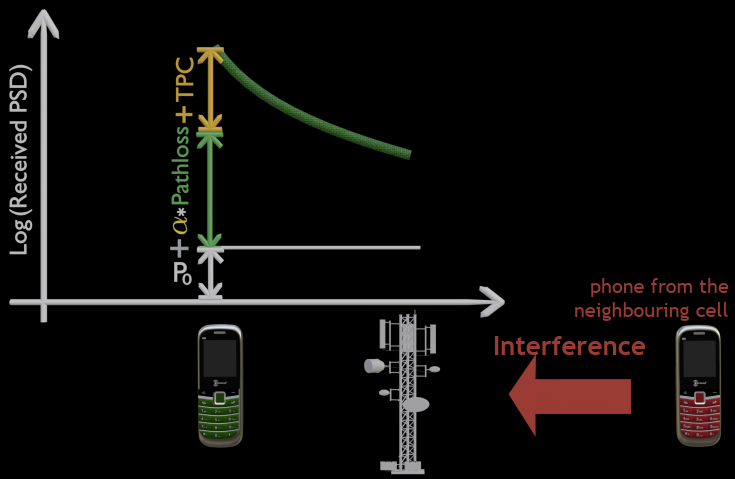
Note: a system running with no TPC feedback is called Open-Loop Power Control. Same formula, nobody talking back.
Trick 3: speak up to speak faster — delta MCS
Alpha and TPC keep your signal alive. The third trick has bigger ambitions: when conditions are good, don’t just survive — go faster.
Quick jargon stop: MCS stands for Modulation and Coding Scheme — essentially, how many bits the phone packs into each transmission. A higher MCS simply means a higher data rate — and that, naturally, demands a stronger signal.
The move: when the base station schedules your phone on a higher MCS — a higher data rate — it can also tell it to raise its transmit power in proportion to that rate, using a parameter called Delta MCS. But how much extra power should the phone raise? Just enough to support the new data rate — an amount computed from Shannon’s capacity equation, the famous law linking signal quality (the signal-to-noise ratio) to the maximum possible data rate. It’s the rule you already know from noisy parties: to talk faster and still be understood, you also have to talk a little louder.

Putting it all together: one equation, five dials
Three tricks, one base recipe. Uplink power control in 5G and 4G stacks them all into a single equation (all values in the logarithmic domain, so everything simply adds):
Transmit Power = P₀ + (alpha × Pathloss) + Delta MCS + TPC + Bandwidth
- P₀ — the target PSD.
- alpha × Pathloss — partial pathloss compensation.
- Delta MCS — adjustment for the data rate.
- TPC — real-time closed-loop corrections.
- Bandwidth — converts the per-frequency PSD into total transmit power: the more bandwidth you’re given, the more total power you need to keep the same PSD. A choir needs more breath than a soloist to sound equally loud on every note.
One last reality check: the result is capped by the maximum power your phone can physically output. The equation may ask for more; the hardware politely refuses. Hence the final form:

And that’s the whole machine. Uplink Power Control makes sure every phone’s signal arrives at the base station at the correct strength — balancing signal quality against battery life and interference, keeping communication reliable and fair for every user in the cell.
Uplink power control in one breath
- Goal: every signal lands at the tower at the same PSD — fairness by design
- Base recipe: P₀ + Pathloss, with pathloss measured from pilot signals
- Alpha ≤ 1 trades a little edge-user speed for battery life and less interference
- TPC commands close the loop — the tower nudges power a decibel or three at a time
- Delta MCS adds power for faster data; everything is capped at the phone’s max (typically 23 dBm)
Next time your battery survives a full day of scrolling, thank the quiet negotiation happening hundreds of times a second between your phone and the tower — shout, whisper, nudge, repeat. And on that one-bar day when it doesn’t survive, at least you’ll know who was shouting. Let me know your thoughts in the comments. Until next time — happy learning!
Leave a Reply