
You know that tiny pause after you send a WhatsApp message, before the second tick appears? That tick is a delivery receipt — and your phone plays the other side of that game all day long. Every chunk of data the 5G tower sends down gets receipted back up, on a dedicated back-channel called PUCCH — the Physical Uplink Control Channel. Let’s break it down, no tech headaches required.
Keep one picture in your head for this whole post: the cell is a classroom. The tower is the teacher, doing most of the talking. Your phone is one student among hundreds — and PUCCH is everything a good student does without leaving the seat: nod, raise a hand, ask the teacher to speak up.
Want to dive deep into the PUCCH formats first? This video has you covered:
Nods, raised hands, and “please speak up”
The teacher talks nearly all the time — video streams, downloads, web pages pouring into the room. But no teacher can run a class without hearing back. That’s PUCCH — the student’s side of the conversation, and only three kinds of little message ever travel on it:
- “Package delivered!” (ACK/NACK). Did the data arrive safely? Your phone replies ACK (acknowledgement — “Yep, arrived perfectly!”) or NACK (negative acknowledgement — “Uh oh, something’s missing, resend please!”). This tiny receipt — the student’s nod or puzzled frown — drives 5G’s retransmission engine, a scheme called HARQ, and it’s the reason your downloads arrive complete and error-free.
- “Can I speak now?” (Scheduling Request). Need to upload a photo or start a video call? Your phone politely asks, “Hey network, can I get permission — resources — to send data up now?” That’s the raised hand.
- “Connection check-up!” (CQI). CQI — Channel Quality Indicator — is a quick health report: “Signal’s awesome, full bars!” or “Bit weak here, maybe ease off.” It’s the student from the back row asking the teacher to speak up — the network uses it to fine-tune your connection for the best possible speed.
So feedback has its own lane. But hundreds of students share one room — who decides when each of them gets to use it?
Why the teacher decides who speaks — and when
The tower runs the room. It decides how much “air time” — network resources — to give each phone’s PUCCH, and it’s all about efficiency. Two things drive the decision:
- Signal strength (channel quality). Good signal? The message gets through clearly with few resources. Weak signal? The network grants more resources so the feedback still lands safely.
- Message size. A quick “Got it!” (ACK) needs almost nothing. A detailed signal report needs a bit more room.
To handle every combination of signal strength and message size, 5G defines several PUCCH formats — let’s meet them.
Five speaking styles: from a quick nod to a full report
Before speaking, every student sizes up two things: how much do I have to say, and can the teacher hear me from where I sit? Your phone does exactly that, then picks a format:
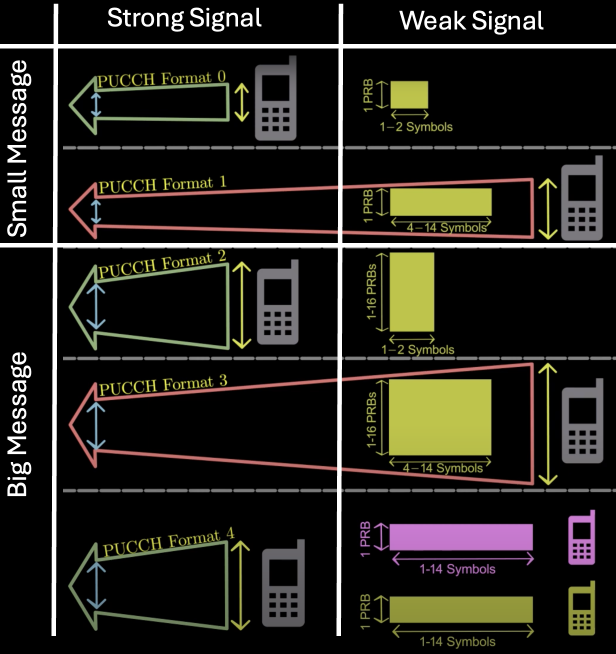
- Formats 0 & 1 — quick “yes/no” answers. Built for lightning-fast, tiny replies.
- Format 0: ultra-short, minimal resources — blink-of-an-eye feedback like “ACK, got it!”
- Format 1: a little slower but more reliable — basic confirmations when the signal is weak.
- Formats 2 & 3 — detailed reports. For when your phone has more to say.
- Format 2: grabs extra frequency space but stays quick in time. Great for bigger messages on a strong signal.
- Format 3: takes both more time and more frequency space. Best for bigger messages when the signal is weak.
- Format 4 — the sharing superstar. It squeezes into a single resource block — just 12 subcarriers wide — yet lets up to four phones send PUCCH at the same time: each phone’s message is stamped with its own orthogonal spreading pattern, so the tower can cleanly un-mix them.
Here’s a nugget straight from the standard: the 3GPP spec TS 38.211 splits these into short formats (0 and 2, lasting just 1–2 OFDM symbols) and long formats (1, 3 and 4, stretching 4–14 symbols), and caps Formats 0 and 1 at only 2 bits of feedback.
| Format | Length (symbols) | Payload | Best for |
|---|---|---|---|
| 0 | 1–2 (short) | ≤ 2 bits | Fast ACK, strong signal |
| 1 | 4–14 (long) | ≤ 2 bits | Reliable ACK, weak signal |
| 2 | 1–2 (short) | > 2 bits | Big report, strong signal |
| 3 | 4–14 (long) | > 2 bits | Big report, weak signal |
| 4 | 4–14 (long) | > 2 bits | Many phones sharing |
One puzzle remains. Nod or essay, every message reaches the tower smeared by noise and echoes — like a neatly written answer sheet that arrives at the teacher’s desk crumpled and smudged. How does the teacher read it anyway?
DMRS: subtitles for a noisy classroom
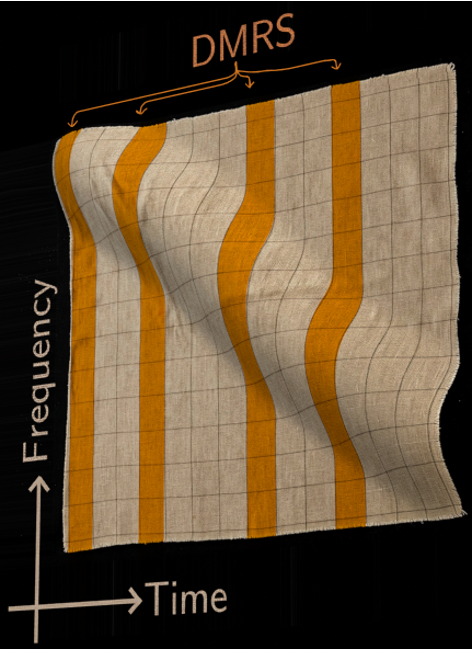
DMRS — Demodulation Reference Signals — are like “decoder clues” or subtitles that your phone sends along with its PUCCH messages. Why bother?
- Wireless signals get messy. Noise and interference smear and blur them on the way up.
- DMRS are known reference points. The tower knows exactly what the DMRS should look like — like a teacher who keeps a handwriting sample from every student. Compare the sample with what actually arrived, learn precisely how the channel distorted it, then un-distort the real message and read it perfectly.
PUCCH in one breath
- PUCCH = your phone’s feedback channel — delivery receipts (ACK/NACK), requests to talk (SR), and connection reports (CQI)
- Smart resources — the network decides how much air time each phone’s PUCCH gets, based on signal strength and message size
- Five formats = five speaking styles — short vs long, tiny vs detailed, solo vs shared
- Weak signal? Take more time — long formats speak slowly instead of shouting, and the tower piles up the energy
- DMRS = decoder subtitles — known patterns that let the tower read your phone perfectly, even through noise
Next time you’re enjoying buffer-free video or super-speedy downloads, remember: somewhere in that giant classroom, your phone is the model student — nodding, raising its hand, and asking the teacher to speak up, hundreds of times a second.
Leave a Reply