
Walk from the couch to the kitchen mid-video-call, and the picture doesn’t even stutter. That smoothness isn’t luck. Behind the scenes, your phone runs a quiet chore: to keep the connection healthy, it constantly re-checks the channel — the invisible radio path between the tower and your hand — by listening to a signal called CSI-RS. This is channel measurement, and it’s the whole purpose of CSI-RS: armed with fresh measurements, the network dynamically adjusts the power and even the direction of its transmissions, keeping your data connection smooth as you move. And here’s the puzzle: how does your phone know exactly when that signal will arrive?
Just like a train schedule tells you exactly when your train pulls in, a smart timing offset tells your phone exactly when to check the CSI-RS signal. No pacing the platform, no missed trains. Let’s explore how that schedule works.
Watch this video to dive into details:
Announce, inspect, report: the ritual behind your signal bars
First, meet the star of the show. CSI-RS stands for Channel State Information – Reference Signal. It’s a pilot signal — a pattern that both sides agree on in advance. The base station (the 5G tower) transmits it, and since your phone already knows what the CSI-RS should look like, it compares the received copy against the perfect original. Every dent and smudge on the received signal reveals what the channel did to it.
The whole ritual takes three steps:
- Announcement. The base station alerts your phone over the PDCCH (Physical Downlink Control Channel) — the tower’s loudspeaker for urgent announcements. It crackles to life: “Attention — the CSI-RS train will be arriving shortly!”
- Inspection. After a set time offset, the base station sends the CSI-RS. Your phone steps onto the platform at exactly that moment and catches it.
- Report. Your phone measures the damage the channel did and sends a report back to the base station.
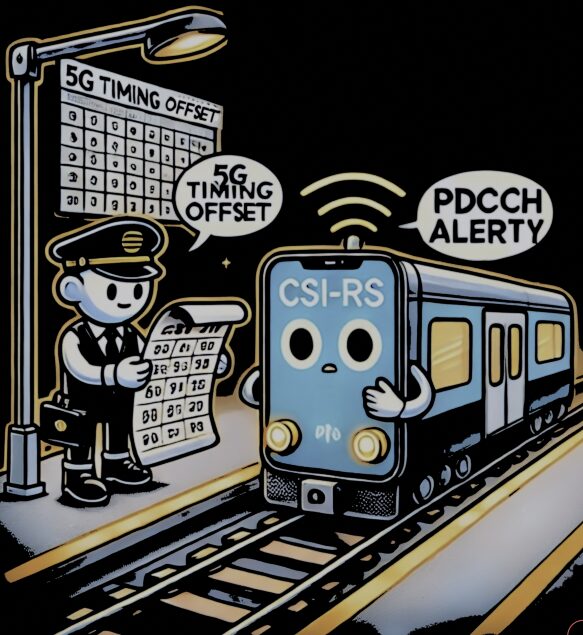
The CSI-RS leaves the depot factory-fresh, but the channel roughs it up en route: echoes leave dents, noise leaves scratches, and the long ride fades the paint. Your phone — the station master — checks every mark against the blueprint and wires the damage list back to the depot. That damage list is the channel measurement.
But the whole ritual hinges on step two: your phone must step onto the platform at exactly the right moment. Where does that timing come from?
Reading the timetable: where the offset hides
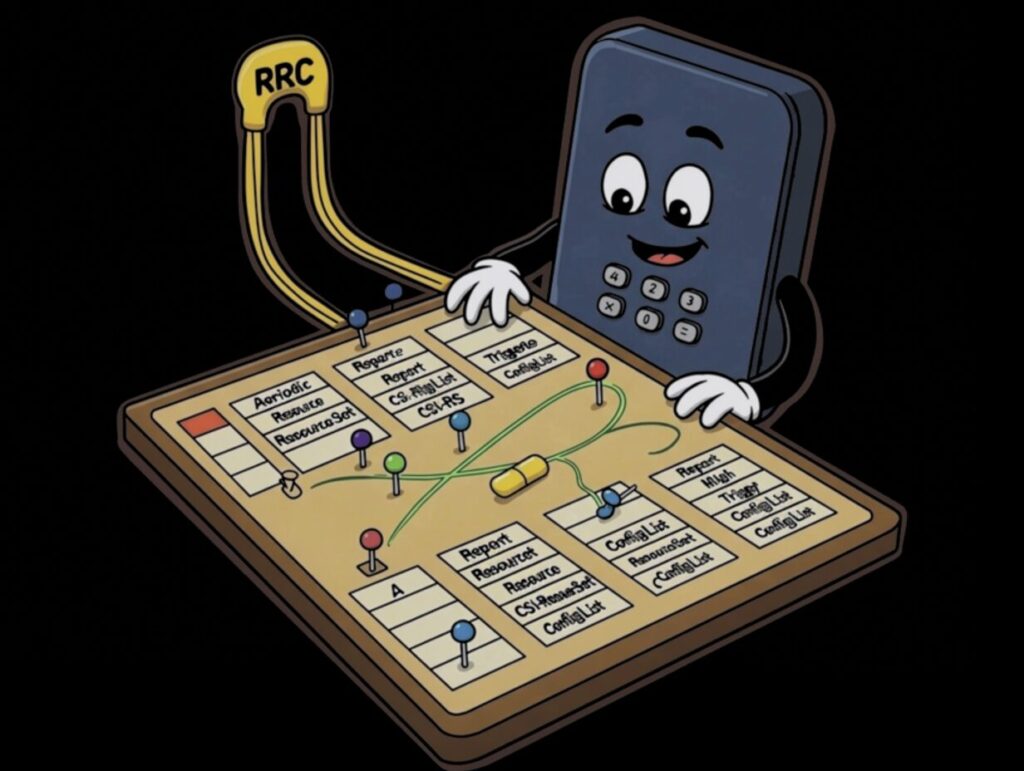
The PDCCH announcement itself carries no clock. The predefined time offset arrives separately, in RRC messages. RRC — Radio Resource Control — is the sit-down configuration channel where the tower hands your phone all its settings, calmly and in advance. And here’s the twist: the RRC message never states the time directly.
Instead, the base station provides a pointer to a “timetable.” Your phone follows this pointer through several lists — all already delivered via RRC — until it finds the exact timing offset — from which your phone works out precisely when the CSI-RS train will arrive at the station. In the actual 5G rulebook, 3GPP TS 38.331, this field is literally named aperiodicTriggeringOffset, and it’s counted in whole slots — in early 5G releases it could point 0 to 6 slots ahead.
Once the phone has the timing offset, the arrival time is one tidy addition:
CSI-RS Arrival Time = PDCCH Announcement Time + Timetable Delay + Precise Symbol in Slot
For example: suppose the announcement lands in Time Slot 10, the timetable delay is 2 slots, and the precise symbols in the slot are 7 and 8. Your phone quietly does the math and gets ready to receive the CSI-RS at Time Slot 12, symbols 7 and 8. Right on schedule.
What punctuality buys: stronger signal, longer battery
All this careful choreography isn’t bureaucracy for its own sake. The flexible timetable exists because different devices have different timing needs — a flagship phone can process a CSI-RS almost instantly, while a cheap sensor needs a few extra slots to get ready. One timetable format serves them all: express trains and slow freight, on the same schedule board.
And the payoff is real. Accurate, on-time measurements mean stronger signals, because the base station always works from fresh channel knowledge — which is exactly what steers beamforming toward your phone.
CSI-RS timing in one breath
- CSI-RS is a known pilot signal — the phone compares received vs. expected to grade the channel
- Three steps: announce (PDCCH) → inspect (after an offset) → report back
- The offset comes from an RRC-delivered timetable; the announcement just points to a row
- Arrival = announcement time + timetable delay + symbol in slot (slot 10 + 2 → slot 12, symbols 7–8)
- One timetable serves every device, flagship to farm sensor — stronger signals, longer battery
Next time your signal bars refuse to budge while you ride a train, remember: your phone is consulting a train schedule of its own, hundreds of times a second, and it never misses a train.
Leave a Reply