
You hit send, and your text lands on a phone across the planet before yours is back in your pocket. In that half-second, your message raced through a hidden city — towers, buried cables, and a “brain” you have never seen. Now, a confession: the official names for these pieces — Core, RAN, RAT, gNodeB — might be the most boring vocabulary in all of wireless. Memorized as a list, they’d put anyone to sleep. So we won’t memorize a list. We’ll tour the city instead — and by the end, those acronyms will feel like old friends, and you’ll never read a “5G rollout” headline the same way again.
Check out the video below for a quick overview:
The network is a city: Core and RAN
Think of a mobile network as a city. Every city has two parts: downtown — city hall and the highways that feed it — and the local streets where people actually live. A mobile network splits exactly the same way — into the Core and the RAN.

The Core Network is the city hall plus the main highways. It’s the brain of the operation — and like any good city hall, it quietly handles the paperwork that keeps the whole city running. Three jobs matter most:
- Managing your connection and services.
- Routing your calls and data to the right place — even across other networks.
- Billing and authentication — checking you are who you claim, and charging you for it.
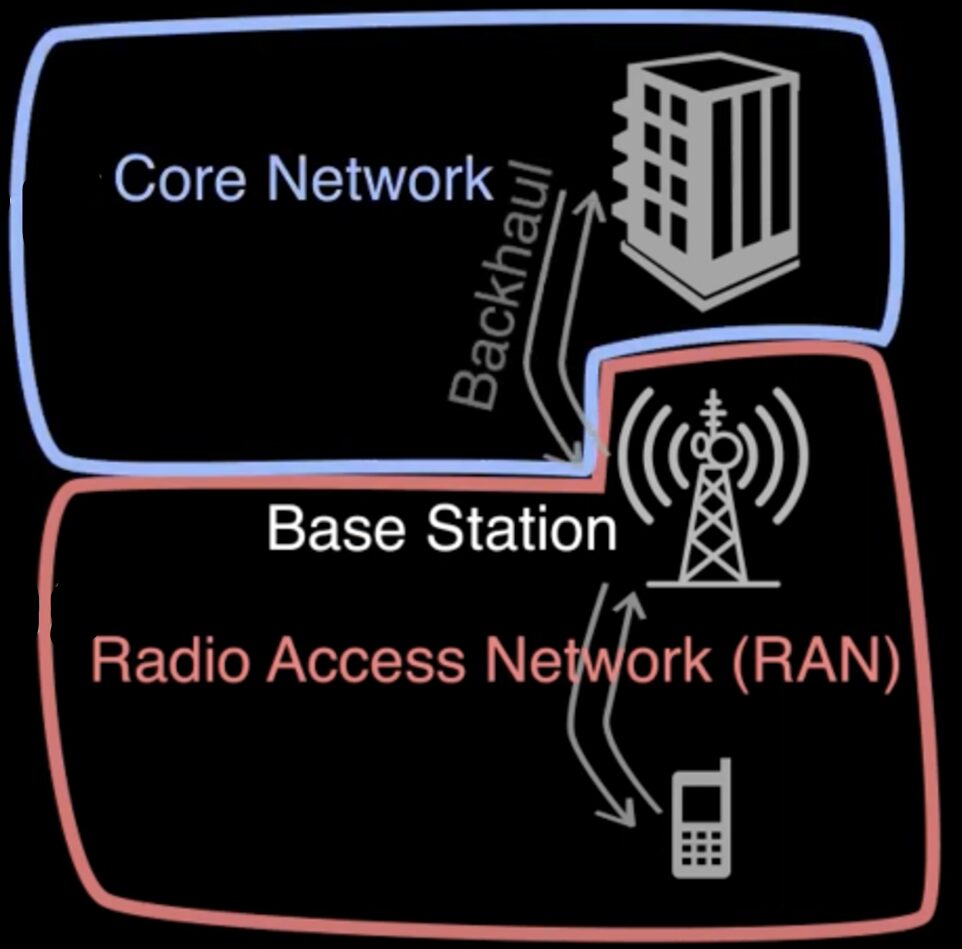
The Radio Access Network (RAN) is the local streets — the part you actually touch. Your phone connects wirelessly to a base station, the cell tower in your neighbourhood. The tower then hands your data to the Core over a link called backhaul — think of it as the on-ramp from your street onto the highway. And just like one city hall serves many neighbourhoods, one Core can manage many RANs.
In one sentence: your phone talks wirelessly to the RAN, and the RAN plugs into the Core, which connects you to the wider world.
Inside the RAN: the streets speak their own language
Here we are on the local streets. Like any city district, this one has its own slang — and the RAN has two key ingredients working together: a language and a translator.
First, the language. The Radio Access Technology (RAT) is the specific wireless “language” spoken over the air. Just like people, your phone must speak a language the network understands. GSM, UMTS, LTE, and NR are all RATs — the languages of 2G, 3G, 4G, and 5G respectively.
Second, the translator. The base station is the RAN’s signal-processing workhorse. It catches the RAT signal arriving over the air from your phone, decodes it back into plain digital data, and sends that data down the backhaul to the Core. In short: the RAT is the language, and the base station is the translator between your phone and the Core Network.
Now that you can tell a generation from its language, let’s add the final layer. Every language needs a script — a way to write it down. Think of English and French: two different languages, both written in the same Latin alphabet. Wireless languages work exactly the same way. Each RAT is written onto the airwaves in a signalling format — its script. 3G’s UMTS is written in a script called WCDMA. And here’s a neat twist: 4G’s LTE and 5G’s NR are two different languages written in the same script — OFDMA. You’ll spot each language’s script in brackets in the table coming up.
Mobile generations: the same city, rebuilt four times
Here’s where beginners usually drown in alphabet soup — because every generation renames everything. New Core, new base station, new RAN, new RAT. But once you see them side by side, the pattern snaps into focus:
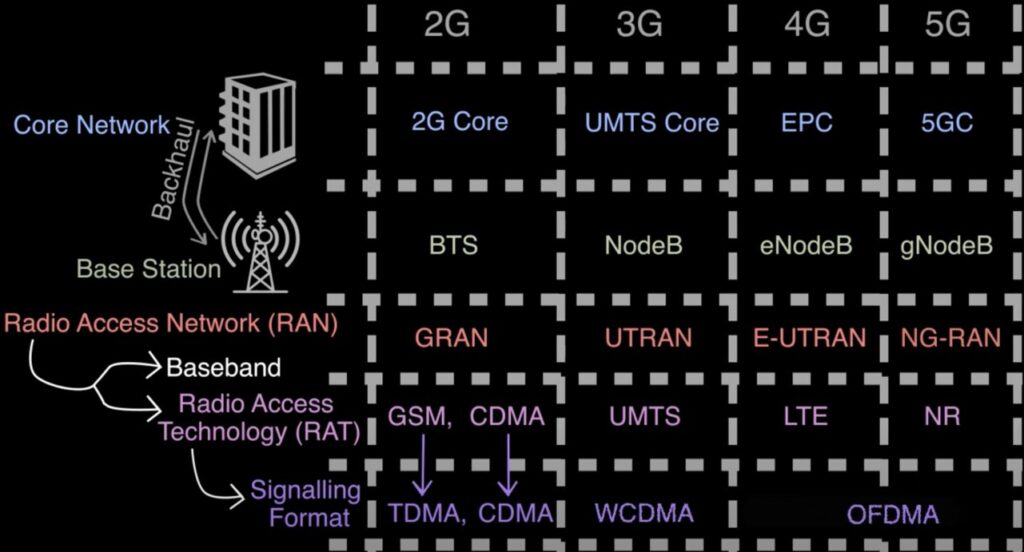
| Generation | Core Network | Base Station | RAN | Wireless Tech (RAT) | What it brought |
|---|---|---|---|---|---|
| 2G | 2G Core | BTS | GRAN | GSM (TDMA/FDMA) | Texting, basic calls |
| 3G | UMTS Core | NodeB | UTRAN | UMTS (WCDMA) | Mobile internet, better voice |
| 4G | EPC | eNodeB | E-UTRAN | LTE (OFDMA) | Faster internet, streaming |
| 5G | 5GC | gNodeB | NG-RAN | NR (OFDMA) | Super-fast speeds, low latency |
Read the table column by column and the soup becomes simple:
- 2G Core, UMTS Core, EPC, 5GC — the Core of each generation: city hall, rebuilt each time for new features and higher speeds.
- BTS, NodeB, eNodeB, gNodeB — all just base stations. Mentally file them as “2G tower”, “3G tower”, “4G tower”, “5G tower”.
- GRAN, UTRAN, E-UTRAN, NG-RAN — the RAN of each generation.
- GSM, UMTS, LTE, NR — the RATs, the wireless languages.
- TDMA/FDMA, WCDMA, OFDMA — the signalling formats in the brackets: the scripts each language is written in.
Each generation rebuilds the same city on the same map — wider highways, a smarter city hall, new slang on the streets. And the rebuilds arrive like clockwork, roughly one per decade: the world’s very first GSM call was made in Finland in 1991, on the Radiolinja network (Wikipedia has the full story); the first commercial 4G LTE networks lit up Stockholm and Oslo in December 2009; and 5G went commercial in South Korea in April 2019.
Why carry this city map in your head?
These terms aren’t just for telecom engineers — a little vocabulary goes a long way. You now see the invisible city that connects you to the world every single day. The next time you read about a “5G rollout” or a “3G shutdown”, you’ll know exactly which piece of the city is changing. And you can always drop “gNodeB” casually into a conversation and see what happens — it might even impress your friends. Maybe!
Want to dig deeper? Wikipedia has solid articles on the Core Network, the RAN, and backhaul. For the raw source of truth there’s 3GPP — the standards body (founded in 1998 as the “3rd Generation Partnership Project”) that writes the 3G, 4G, and 5G specifications — it later inherited the GSM specs from Europe’s ETSI, and kept its 3G-era name the whole time. Warning: technical! For friendlier reading, try industry sites like LightReading, TelecomHall, ShareTechnote, and TechPlayOn.
Cellular entities in one breath
- Core Network = city hall: routing, billing, authentication
- RAN = local streets: the base station your phone talks to, plus its backhaul on-ramp
- RAT = the wireless language: GSM → UMTS → LTE → NR
- Base station = the translator: BTS → NodeB → eNodeB → gNodeB
- Each generation renames all four — but the city map never changes
Next time your text lands on the other side of the planet in under a second, picture the journey: a whisper over the air to your neighbourhood tower, a sprint down the backhaul on-ramp, a routing decision at city hall — and the same trip in reverse at the far end. Let me know your thoughts in the comments. Until next time — happy learning!
Leave a Reply